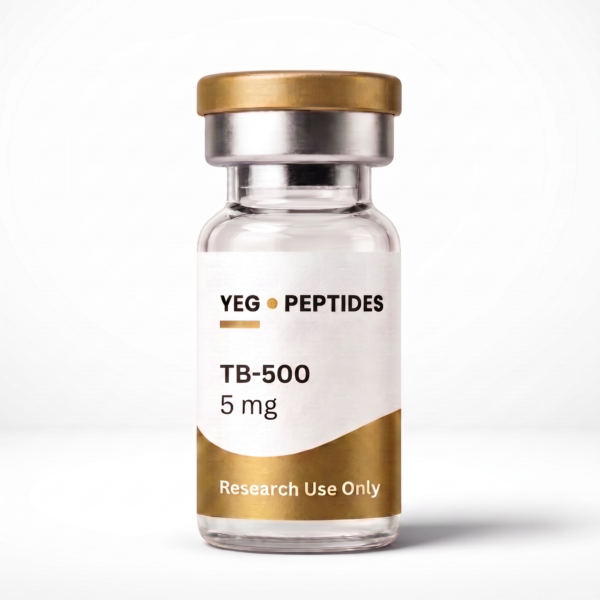
TB-500 is a synthetic peptide fragment corresponding to the active site of Thymosin Beta-4 (Tβ4), a naturally occurring protein present in high concentrations in blood platelets and wound tissue. Supplied in a 5 mg vial, it is widely researched for its exceptional ability to promote cell migration, blood vessel formation, tissue repair, and flexible mobility across cardiac, muscular, and connective tissues.
What Studies Show (Layman Summary):
Because of its lightweight molecular structure, TB-500 diffuses rapidly through tissues to orchestrate systemic recovery. Preclinical research models highlight its potential for:
Connective & Muscle Repair: Accelerates healing in damaged tendons, ligaments, joint structures, and skeletal muscle tissue.
Cellular Mobility & Migration: Regulates actin polymerization, enabling repairing cells to travel rapidly to injured sites.
Angiogenesis & Blood Flow: Promotes the growth of new blood vessels, delivering oxygen and vital nutrients directly to injured tissue.
Flexibility & Stiffness Reduction: Helps reduce tissue inflammation and excessive scarring, improving joint mobility and compliance.
How It Works (Research Mechanism)
TB-500 functions primarily through interaction with cellular cytoskeletons and vascular pathways:
Actin Sequestration & Polymerization: Binds G-actin monomers to regulate intracellular microfilament assembly, a crucial process for cell structure, movement, and repair.
Endothelial Cell Migration: Stimulates vascular endothelial cell movement to initiate new capillary growth (angiogenesis) at damaged tissue sites.
Inflammatory Cascade Downregulation: Suppresses pro-inflammatory cytokines and decreases excessive collagen deposition to prevent stiff scar tissue formation.
Low Molecular Weight Advantage: Diffuses rapidly across systemic barriers to target both acute local injuries and distant cellular inflammation.
Research Dosing & Usage Parameters
In research protocols, TB-500 is evaluated through loading and maintenance phases to optimize cellular uptake and sustained healing:
Common research parameters evaluate:
Loading Phase: 2.0 mg to 5.0 mg total per week (often split into 2 doses per week) for 4 to 6 weeks.
Maintenance Phase: 2.0 mg to 2.5 mg administered once every 2 weeks to sustain biological repair markers.
Reconstitution & Concentration Calculation
Adding 2.0 mL of bacteriostatic water or sterile laboratory diluent creates a stock solution concentration of 2.5 mg/mL (250 mcg per 0.1 mL).
Volumetric Ratio Breakdown (with 2.0 mL reconstituted):
0.20 mL (20 units on an insulin syringe) = 500 mcg (0.5 mg) of active TB-500.
0.40 mL (40 units) = 1,000 mcg (1.0 mg) of active TB-500.
0.80 mL (80 units) = 2,000 mcg (2.0 mg) of active TB-500.
1.00 mL (100 units / full syringe) = 2,500 mcg (2.5 mg) of active TB-500.
Storage & Handling Specifications
Store unopened lyophilized vials in a cool, dark environment shielded from direct light exposure. Following reconstitution with bacteriostatic water, maintain stock solutions refrigerated between 2°C – 8°C (36°F – 46°F). Reconstituted stock solutions should be utilized within 30 days to ensure optimal peptide stability and biological integrity.